A Practical CMO Checklist for 2026
Every CMO I speak to today is deeply informed — and navigating an unprecedented volume of decisions.
Not because there aren’t ideas. But because there are too many choices competing for attention.
AI, CTV, creators, commerce, content, platforms — everything is moving faster than organisational muscle. And most leadership conversations are no longer about what to do, but what to prioritise, what to pause, and what to stop chasing.
This is not another trends list. It’s a decision checklist I believe CMOs in India should keep handy as we head into 2026.
Something to return to every quarter. Something to use internally — and with agencies.
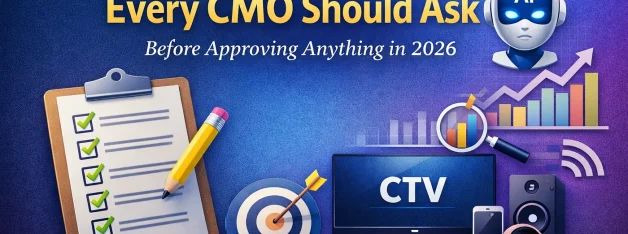
10 Questions Every CMO Should Ask Before Approving Anything in 2026
1. Is AI being used to think faster — or just work cheaper?
AI adoption has moved from novelty to default. The real question now is how it’s being used.
- Is AI helping compress decision time?
- Or is it simply replacing junior effort without improving judgment?
- Is there a clear human checkpoint before anything goes live?
AI should function as a second brain, not a cheaper intern.
2. Have we clearly defined what not to automate?
Not everything should be touched by AI. Especially:
- Brand voice and manifesto
- Crisis communication
- High-stakes storytelling
- Founder and leadership narratives
Automation without boundaries leads to brand dilution — quietly, and irreversibly.
3. Do we have a quarterly experimentation budget — with clear kill rules?
Most organisations talk about innovation. Very few structure it. Ask yourself:
- Is 5–10% of spend ring-fenced for experimentation?
- Are tests time-boxed (30–60 days)?
- Do we shut down failures quickly and cleanly?
In India, innovation rarely dies from failure — it dies from prolonged indecision.
4. Is our CTV strategy actually “connected”?
Too many CTV plans today are just TV plans in disguise. Ask:
- Can we retarget CTV viewers on mobile?
- Are we leveraging second screens, audio, or household-level mapping?
- Are we buying outcomes — or just impressions?
If your CTV plan can’t talk to mobile, it’s incomplete.
5. Are we optimising for attention — or just presence?
Reach has never been easier to buy. Attention has never been harder to earn.
- Do we know where users actually pause?
- Are we tracking watch-time, sound-on, scroll-stops?
- Are we designing content for how India consumes, not how decks present?
Presence without attention is invisible spend.
6. Do we have clear AI guardrails across teams and agencies?
As AI becomes embedded across workflows, consistency becomes fragile. Strong CMOs are now asking for:
- Prompt libraries aligned to brand tone
- Approved vocabularies and no-go zones
- Clear rules on where AI drafts end and human judgment begins
Standardise the thinking — not the output.
7. Are our content formats designed for reuse, not reinvention?
The economics of content have changed. One shoot should fuel:
- Long-form narratives
- Short-form cut-downs
- Statics, explainers, audio snippets
In 2026, content value will come from deconstruction, not creation.
8. Have we actively reduced decision fatigue for our teams?
Burnout rarely comes from volume alone — it comes from ambiguity. Ask:
- Are briefs clearer than last year?
- Are KPIs fewer, but sharper?
- Are reviews faster — or just louder?
Tired teams don’t innovate. They execute mechanically.
9. Do we know which metrics we will stop chasing?
Maturity is often defined by what you stop measuring. It may be time to let go of:
- Vanity reach
- CTR without context
- Platform-led benchmarks with no business meaning
What you stop chasing defines your focus more than what you add.
10. Are we building internal capability — or permanent dependency?
Agencies are critical partners. But institutional knowledge must live somewhere. Ask:
- What must stay in-house?
- What can partners do faster and better?
- Where is learning being documented and retained?
Outsourcing without learning is strategic debt.
(P.S: To ensure this doesn’t remain a “nice read”, I’ve converted this thinking into a working spreadsheet that CMOs and marketing leaders can actually use:
- as an internal review checklist
- in agency conversations
- as a quarterly self-audit
You’ll find the downloadable link here https://www.bcwebwise.com/resources?open=cmo-checklist
I plan to revisit this checklist myself every quarter. If you use it and find gaps, I’d genuinely love to know what you’d add.
About Author

CHAAYA BARADHWAAJ
Chaaya Baradhwaaj founder of BC Web Wise. Her opinions here are based on watching the digital media evolve in the country very closely for over two decades.